English
On the so-called ‘day ahead’ market for electricity, the hourly rates are set every day for the following day. People who have a dynamic contract with their energy supplier pay these hourly rates with a small surcharge on top. The rates are based on expected supply and demand. The demand for electricity is high when people are awake and working, and low at night. Thanks to all the wind turbines and solar panels, the supply of electricity is high when the wind is blowing hard and/or the sun is shining, and low on windless and heavily clouded days.
On an average day, the graph of the electricity rates during the day looks something like the picture below. At night, the price is low because there is little demand, while wind turbines might still be turning and while nuclear or coal-fired power stations are still at work because they cannot simply be switched off. Then there's a peak in the morning, when everyone gets up and gets ready to go to school or work, and offices and factories all start to draw electricity. Then the price drops again around noon because solar panels start to produce a lot and send their surplus into the grid. And when the sun finally sets and people come home from work and start cooking or watching TV, we usually see the highest peak of the day.
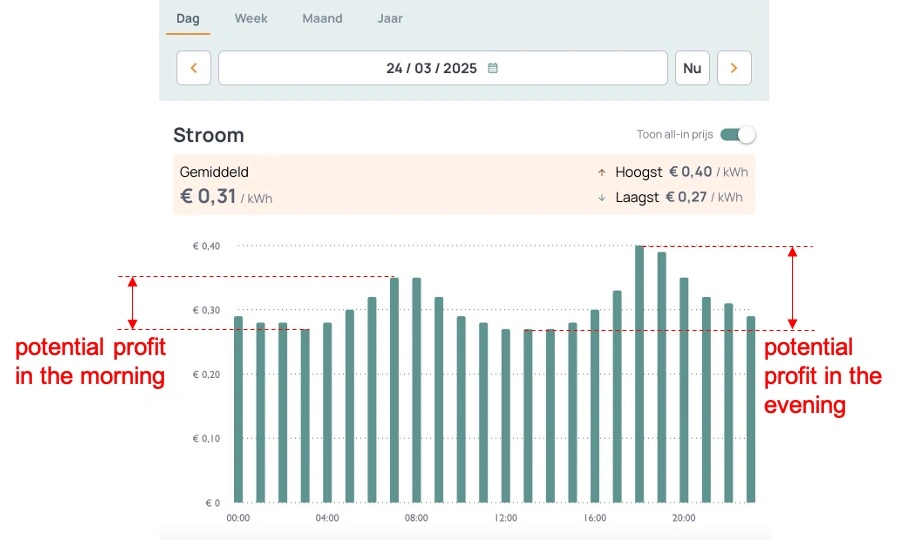
Hourly rates of electricity on an average day. The morning and evening peaks are clearly visible. The red text indicates how a battery can profit from the differences in price
This variation in prices gives the home battery the opportunity to earn money twice a day: once by charging at night and completely emptying again during the morning peak, and then a second time by charging around noon and releasing the stored power in the evening. The greater the differences between the lowest and highest prices in each period, the greater the profit. And guess what? The difference between the lowest and highest price has been increasing over the years: that means there's more and more money to be made with this form of trading (which is very different from trading on the imbalance market, which we wrote about earlier). Below is a graph we made of the average possible daily earnings of a 10 kWh battery that is charged and discharged twice a day. The earnings are based on the daily hourly prices.
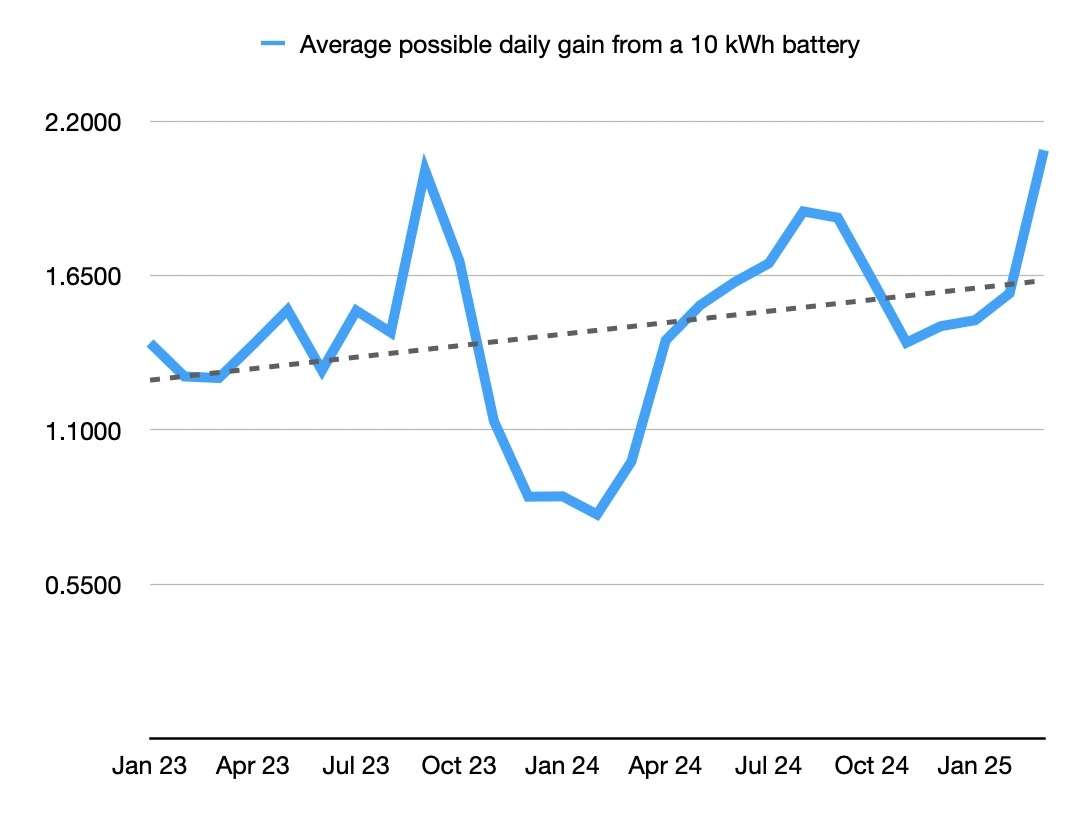
The potential daily profit of a 10 kWh battery that uses the differences between the lowest and highest prices twice a day. The increasing differences provide higher profit, especially in the summer months.
The line is going up, but the question is whether this will continue in the future. There are two opposing influences on this development; on the one hand, more and more renewable energy is being added in the Netherlands, which will cause prices to diverge further; on the other hand, more and more storage capacity is being connected to the grid in the form of batteries, both the home version as well as large industrial battery systems. These batteries have a dampening effect on price fluctuations. Given the fact that battery storage will remain relatively expensive for the time being, compared to the price of wind turbines and solar panels, we expect the line to continue to rise a lot in the coming years.
Another important development is that prices on the dynamic market will soon no longer be determined per hour, but per fifteen minutes. This means that there will be even more variation in prices, with perhaps even deeper lows and higher peaks, and therefore even more opportunity for earning money.
For the next year and a half, we can simply send the electricity discharged from a home battery back to the grid with impunity in order to make a profit. But after 1 January 2027, things will be different: you will no longer receive the same amount for fed-in electricity as what you pay for electricity consumed, even if you have a dynamic energy contract. That's why, from that moment on, it will mainly be about covering your own consumption. By using cheap night-time electricity to cover your morning consumption, and cheap afternoon electricity to provide yourself with power during the evening peak, you will make a profit from a home battery. But remember: in order to maximise profit, the battery must always be reasonably empty so that it can be refilled afterwards. If the battery is too big, it will never empty out, and so there'll be unused capacity. A battery that is too big is therefore a bit of a waste of investment.
You get the most out of a battery is when you use it frequently. In the best case scenario, this means fully charging and discharging twice a day, or 2 full cycles per day. The SMA batteries that Zonnefabriek installs are guaranteed to function for at least 8000 cycles, or almost 11 years of fully charging and discharging twice a day. This means that these batteries can handle what's being asked of them.
Filling the battery from the grid at night is something that you can already set on the ‘classic’ Sunny Portal, but not yet on the newer SMA portal ennexOS. But as it is now on Sunny Portal, it is not very flexible: you can choose a specific time to charge (for example 3 o’clock at night), but you cannot easily make this charge time dependent on the actual rates at that time. Fortunately, SMA is working on a link between the Sunny Home Manager and the EPEX spot market that should automate this process. According to SMA, this link will only be ready after the hourly rates have been replaced by 15-minute rates, i.e. after June this year. At Zonnefabriek we expect that the connection will not be ready until sometime in the third quarter.
Charging and discharging based on dynamic rates is a smart way to benefit from a home battery. It is also a more understandable and predictable way than that other trading option, namely trading on the imbalance market, even though, according to many trading parties, the imbalance market currently gives more profit than the day-ahead market.
Zonnefabriek currently has an interesting offer for those who want to purchase SMA home batteries. Especially in combination with the future possibilities of the Sunny Home Manager, you won't regret it! Ask about the possibilities via the button below.