English
Electricity is a basic need for people in the West. In emergency situations, we still need to have access to light and heat, and we need to be able to charge our phones and listen to the radio. If a disaster occurs, or if war breaks out, the energy supply may be the first to be affected. We see this happening in Ukraine, for example, where people are often without electricity for hours and sometimes days.
Fortunately, we can do something about that! With solar panels on the roof and/or a home battery, you can be assured of electricity in the event of a power failure, even if it is only temporary. The time that you can bridge with your own electricity depends on a number of things:
The options for back-up power are constantly changing. Zonnefabriek currently offers the option of installing Back-Up power with systems from SMA and SunPower. We explain the different alternatives below.
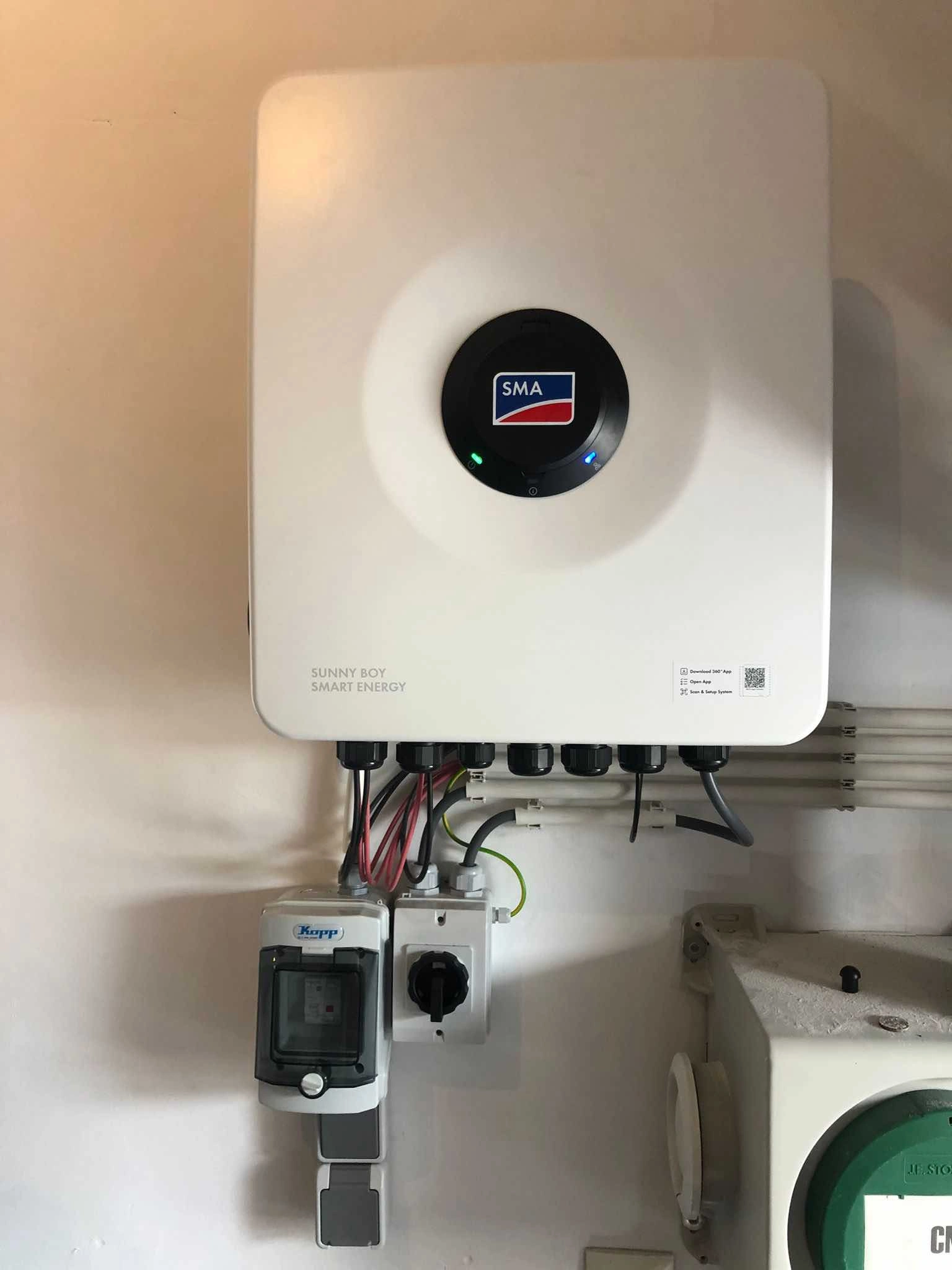
SMA Sunny Boy Smart Energy inverter with two additional sockets at the bottom left: these work when the grid fails and are powered purely by the solar panels (this system has no batteries)
The Sunny Boy Smart Energy is a 1-phase hybrid inverter (note: with SMA, the Sunny Boy is always 1-phase, while the Sunny TriPower is always 3-phase). This device only came onto the market in 2024 and is becoming increasingly popular. Both batteries and solar panels can be connected to the inverter (hence the designation: hybrid), but it also works fine without batteries.
One of the nice features of the device is that there is the option to connect a Back-Up socket to it if desired. What is quite unique is that this socket also works when no batteries are connected to the inverter: as long as the sun is shining, the socket can convert that solar power directly into usable alternating current from that one socket!
The application does have a few limitations: it can only supply 1 or a maximum of 2 sockets, the socket must be switched on and off manually (via a push button: the switch to emergency power does not happen automatically), and of course it only works when there is sufficient sunlight on the panels (ergo: during the day). But anyway, it does offer a way to continue to benefit from the panels when the grid fails and will supply enough power for some basic things such as a refrigerator, a phone charger, etc. Installing the emergency power socket costs some extra money on top of the normal installation: our consultants can provide you with the details.
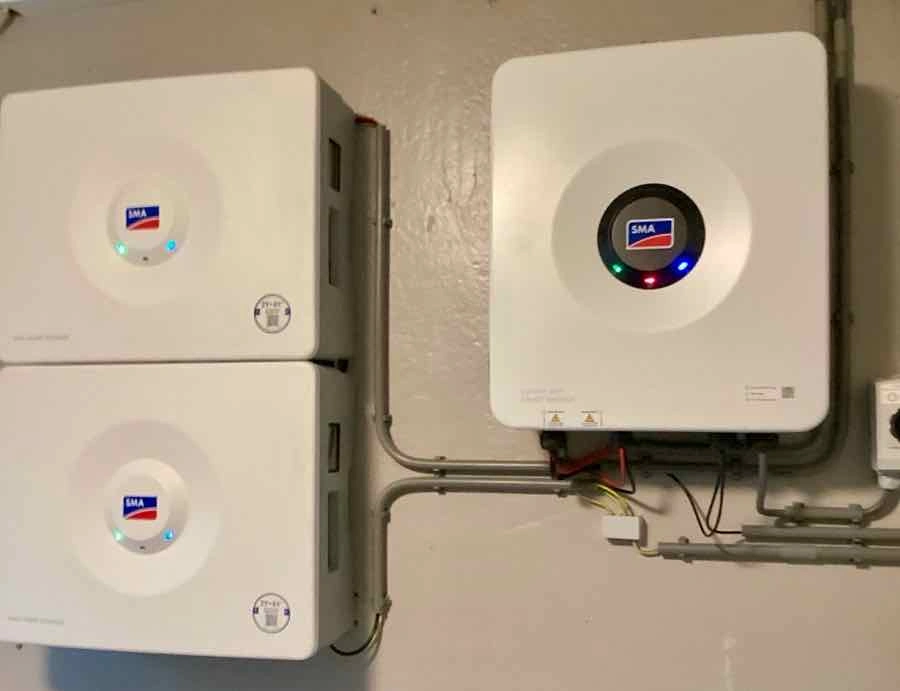
SMA Sunny Boy Smart Energy with two SMA Home Storage batteries of 3.2 kWh each on the left
As mentioned, batteries can also be connected directly to the same Sunny Boy Smart Energy. In that case, the aforementioned socket also works at night, when there is no sun - provided of course that there is sufficient power stored in the batteries. With batteries, you can last longer than without, that is clear. During the day, the battery that was emptied out in the night, is refilled with the help of the solar panels. In this way, you can bridge power outages that last for days. You can set a minimum reserve limit for the battery, in order to be sure that there is always a certain amount of reserve power in the battery, should the grid indeed fail unexpectedly.
A new option is to install an automatic switchover system with this inverter, instead of the one emergency power socket. With such an automatic switchover system, multiple circuits in the home can be supplied with power. The system also works automatically, i.e. if a grid failure is detected, you don't have to press a button to switch on the emergency power: the system switches over automatically. This solution requires quite a bit of installation work in the distribution board and is therefore a lot more expensive than the simple option with one socket.
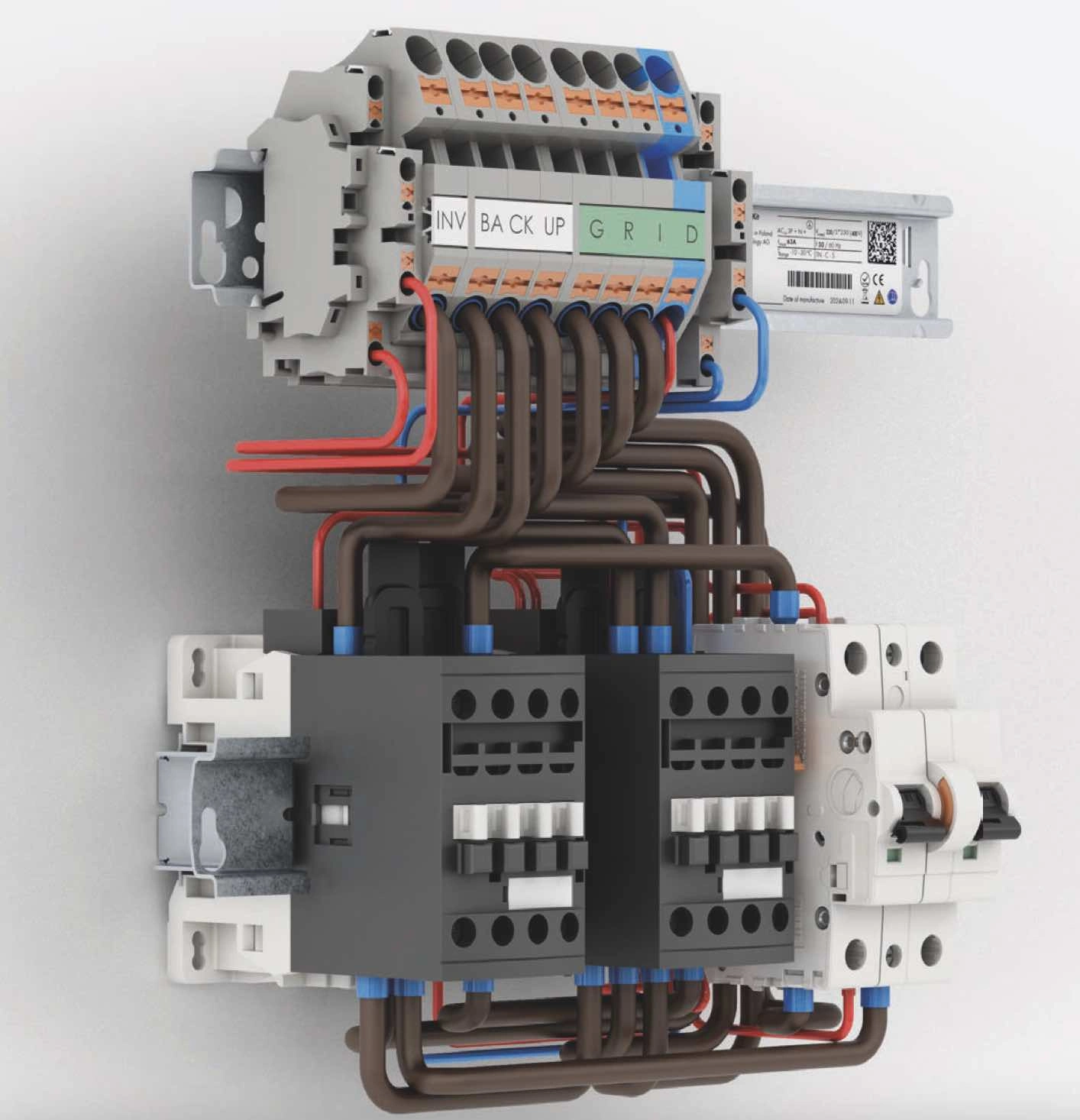
The new SMA backup kit: this can be installed in a meter cupboard and can automatically ensure that the Sunny Boy Smart Energy continues to supply a number of sockets in the house in the event of a power failure
The three-phase version of the SMA inverter offers higher power, up to 10 kW. This inverter has a built-in backup feature, which starts immediately if the grid fails. For this inverter, the backup only works if batteries are also installed; it does not work with solar panels alone.
For people who want to use this form of backup, we set up a separate distribution box, to which the 'essential' consumers are connected: these consumers are normally powered from the grid via the inverter, but in the event of a grid failure, the inverter takes over the power supply very quickly. As a consumer you wouldn't even notice this rapid switchover. Additional costs are charged for installing the backup output with an additional distribution box; our consultants can tell you approximately how much that is.
Our newer SunPower Reserve home batteries also have an optional backup output. Normally we don't use them, because these batteries are primarily used to trade on the electricity markets (the ‘day-ahead’ market and the ‘imbalance’ market). Therefore, it is not certain that there will be sufficient energy stored in the batteries when the grid fails. We also don't connect solar panels to the SunPower Reserve, because they can partly hinder the ability to trade.
Nevertheless, it is also possible to use the emergency power output on these devices. We can install this immediately upon delivery, or at a later time when the threat of war or other disasters has come closer. In any case, it is good to know that it is possible.
The demand for back-up power supply is still low compared to the demand for Zonnefabriek’s ‘regular’ products, such as solar panels, home batteries, heat pumps and EV-chargers. This is mainly because we only have to deal with very few power outages in the Netherlands. According to Netbeheer Nederland, the power goes out for an average of 20 minutes per household per year. But if we want to take Rutte's words to heart and prepare ourselves for a possibly challenging future, then it might be a good idea to inquire about the possibilities for your solar panel system. Our advisors will be happy to discuss it with you.